
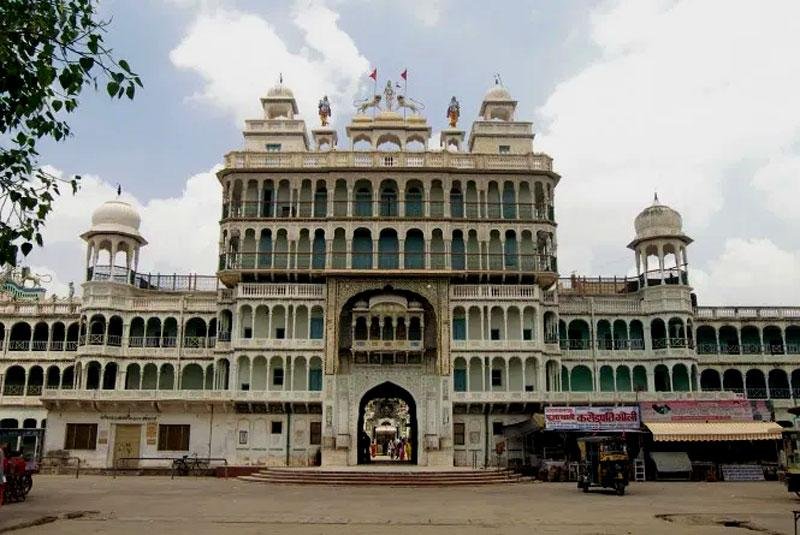
Introduction to Rani Sati Dadi Aarti
Rani Sati Dadi Aarti is a daily devotional ceremony performed at Shri Rani Satiji Mandir in Jhunjhunu, Rajasthan. The worship honours Rani Sati Ji, also remembered within temple tradition as Narayani Devi and affectionately addressed by devotees as Dadiji.
Unlike many Hindu shrines centred on an anthropomorphic idol, the principal focus of worship here is a trishul, or sacred trident. Temple tradition presents it as a symbol of Shakti—the divine feminine power associated with courage, protection and spiritual strength. During the Aarti, priests offer illuminated lamps before this sacred representation while bells, prayers and devotional music fill the marble temple.
Several ceremonies structure the day, beginning with Mangala Aarti in the Brahma Muhurta and concluding with Shayan Aarti at night. Sunrise, midday and sunset worship create additional devotional pauses between these principal ceremonies.
Devotees attend Rani Sati Dadi Aarti to express gratitude, pray for their families and experience collective worship. For many Marwari families, the ceremony also carries a strong emotional connection with inherited traditions preserved across generations.
History of the Temple and Its Aarti Tradition
Shri Rani Satiji Mandir stands in Jhunjhunu, an important town in Rajasthan’s Shekhawati region. The official temple trust describes the shrine as centuries old and identifies the trishul in the principal worship area as the representation of Shakti associated with Narayani Devi.
Traditional accounts concerning Rani Sati Dadi differ in their dates and details. These narratives connect Narayani Devi with courage, family devotion and spiritual power. They belong to a living faith tradition and should be understood in their historical and cultural setting rather than treated as encouragement of sati. The practice of sati is illegal in India, and present-day worship at the temple centres on Shakti, prayer, service and family devotion.
Over time, the shrine developed into an extensive marble complex supported by devotees, particularly members of Marwari communities. The complex also contains temples dedicated to Lord Ganesha, Shiva, Hanuman, Satyanarayan Ji, Navagraha and the Sodash Matrikas.
Daily Aarti became one of the principal ways through which devotees maintained their connection with Dadiji. The ritual calendar follows the movement of the day: awakening worship before dawn, prayers around sunrise, a midday offering, evening worship at sunset and the concluding Shayan ceremony.
The temple’s most important annual observances include Bhadra Amavasya and Mangsir Badi Navami. During these occasions, the everyday Aarti tradition becomes part of a much larger gathering involving special worship, decorations and devotional participation.
Spiritual Significance of Rani Sati Dadi Aarti
Aarti is the ceremonial offering of light before the divine. The flame represents knowledge, purity and the removal of inner darkness. When the priest moves the lamp before Dadiji’s sacred trishul, devotees symbolically offer their thoughts, worries and gratitude to Shakti.
The trishul is traditionally associated with divine strength and the power to overcome negativity. Its three points receive different symbolic interpretations, including the balance of creation, preservation and transformation. At Rani Sati Temple, it allows worshippers to concentrate on spiritual power rather than on a conventional human-shaped idol.
The bells heard during Aarti help draw the mind away from ordinary distractions. Incense creates a fragrant devotional environment, while flowers communicate reverence and gratitude. Singing together turns individual prayers into a shared spiritual experience.
Addressing the revered figure as “Dadi” gives this worship a particularly personal quality. The word means grandmother, conveying affection, protection, wisdom and the emotional security associated with an elder of the family.
Benefits of Attending Rani Sati Dadi Aarti
- Spiritual calm: Concentrating on the lamp, prayers and music can help quieten an anxious or distracted mind.
- Strengthened faith: Joining the ceremony allows devotees to renew their connection with Dadiji and Shakti.
- A sense of protection: Many worshippers approach Dadiji with prayers concerning family welfare and emotional strength.
- Collective devotion: Participating with other devotees creates a feeling of belonging and shared faith.
- Family connection: The Aarti helps many Marwari families continue traditions followed by earlier generations.
- Mindful reflection: Morning and evening ceremonies offer natural pauses for gratitude and self-examination.
- Cultural understanding: Visitors experience the distinctive devotional practices of Jhunjhunu and the Shekhawati region.
- Respect for tradition: Attending responsibly supports the continuation of an established form of worship.
These benefits are spiritual and reflective. Participation should not be presented as a guaranteed solution to illness, financial difficulty or another material concern.
What Makes Rani Sati Dadi Aarti Special?
The sacred trishul makes this Aarti visually and symbolically distinctive. Rather than concentrating exclusively on a sculpted image, devotees direct their prayers towards a representation of divine feminine energy.
The white-marble setting adds to the ceremony’s atmosphere. Its polished surfaces reflect the glow of the lamps, while the enclosed prayer spaces amplify bells, music and collective responses.
The sequence of daily worship is another defining feature. The first Aarti begins in the Brahma Muhurta, long before ordinary activity fills the town. Midday worship marks the transition between the morning Darshan period and the afternoon closure. Sandhya Aarti follows sunset, while Shayan Aarti formally concludes the devotional day.
Priests guide the ceremony through the offering of lamps, prayers, incense, flowers and Bhog. Devotees participate by standing respectfully, folding their hands and joining familiar responses without obstructing the ritual area.
After the evening Aarti, the official temple schedule also lists a musical-fountain presentation. This creates a distinctive transition from collective worship to the illuminated evening atmosphere of the larger complex.
On Bhadra Amavasya and Mangsir Badi Navami, the shrine receives significantly larger congregations. Decorations, devotional programmes and special arrangements add intensity to the Aarti, although devotees should expect longer queues and restricted movement.
Rani Sati Dadi Aarti Timings
The official temple trust publishes separate schedules for summer and winter. At this temple, summer is counted from Holi to Diwali, while winter is counted from Diwali to Holi.
Summer Aarti Schedule: Holi to Diwali
- Mangala Aarti: 4:00 AM
- Morning worship: According to sunrise
- Midday Aarti: 12:45 PM
- Sandhya Aarti: According to sunset
- Shayan Aarti: 10:45 PM
Winter Aarti Schedule: Diwali to Holi
- Mangala Aarti: 5:00 AM
- Morning worship: According to sunrise
- Midday Aarti: 12:45 PM
- Sandhya Aarti: According to sunset
- Shayan Aarti: 9:45 PM
The summer Darshan periods are officially listed as 4:00 AM to 1:00 PM and 3:00 PM to 11:00 PM. In winter, they are 5:00 AM to 1:00 PM and 3:00 PM to 10:00 PM. The temple remains closed to ordinary visitors between the morning and evening sessions.
Because the morning and Sandhya ceremonies are linked to sunrise and sunset, their exact clock times change through the year. Devotees should arrive at least 20 to 30 minutes early and check the temple notice for that day.
Note: Timings may change during festivals or according to temple administration.
Rituals Performed During Rani Sati Dadi Aarti
Lighting of Sacred Lamps
The priest lights the Aarti lamp and offers it before the sacred trishul. Its radiance represents divine knowledge and the presence of Shakti.
Invocation and Devotional Prayer
The ceremony includes prayers honouring Dadiji. Devotees may join the familiar responses while allowing the appointed priests to lead the worship.
Ringing of Bells
Temple bells sound during important stages of the Aarti. Their resonance marks the sacred moment and helps the congregation maintain attention.
Conch and Ceremonial Sound
A conch may be sounded during the worship sequence. In Hindu ritual, its sound traditionally signifies auspiciousness and spiritual purification.
Flowers, Shringar and Incense
Flowers and decorative Shringar express love and reverence, while incense fills the worship space with fragrance. The temple maintains a daily Shringar tradition for Dadiji.
Bhajans and Musical Devotion
Devotional songs create a warm and participatory atmosphere. The congregation should follow the temple’s rhythm rather than interrupting it with separate loud chanting.
Bhog and Prasad
Food is ceremonially offered as Bhog. When Prasad is distributed, devotees should accept it respectfully and avoid wasting it.
Temple Dress Code and Visitor Guidelines
- Wear modest, clean clothing suitable for a sacred place.
- Keep shoulders and knees covered and avoid revealing attire.
- Remove footwear at the designated counter before entering.
- Maintain silence around the principal prayer area.
- Stand behind barriers and respect spaces reserved for priests.
- Follow the queue and avoid pushing during crowded Aartis.
- Do not touch the trishul, lamps, decorations or ritual objects.
- Check the displayed rules before taking photographs or videos.
- Avoid flash, phone calls and disruptive recording during worship.
- Accept Prasad respectfully and dispose of waste responsibly.
- Supervise children carefully in crowded areas.
- Follow instructions from temple staff and security personnel.
Photography rules can differ between the outer complex and the main worship area. Permission in an exterior courtyard should never be assumed to include the sanctum or an ongoing Aarti.
Best Time to Attend Rani Sati Dadi Aarti
Mangala Aarti is ideal for visitors seeking a quiet and meditative atmosphere. It begins at 4:00 AM during the Holi-to-Diwali period and at 5:00 AM between Diwali and Holi.
Sandhya Aarti is better suited to devotees who want to experience the lamps, bells and collective energy of evening worship. Since it follows sunset, the exact time moves seasonally.
October to March generally provides comfortable weather for visiting Jhunjhunu. Bhadra Amavasya and Mangsir Badi Navami offer the most elaborate devotional setting but also attract the largest crowds.
First-time visitors who want an orderly experience should consider an ordinary weekday. Those arriving for Mangala Aarti may arrange accommodation in Jhunjhunu through Mudras Stays and reach the queue before the temple opens.
Nearby Attractions
- Khetri Mahal: Often called the Wind Palace of Jhunjhunu, this historic structure is recognised for its arches, open corridors and unusual architectural character.
- Modi and Tiberwala Havelis: These Shekhawati havelis display painted façades and decorative details associated with the region’s mercantile history.
- Mandawa: This heritage town is known for frescoed havelis, narrow lanes and the artistic landscape of the wider Shekhawati region.
Interesting Facts About Rani Sati Dadi Aarti
- The principal sacred representation is a trishul symbolising Shakti.
- Devotees affectionately address Rani Sati Ji as Dadiji, meaning grandmother.
- The official calendar divides its timing seasons at Holi and Diwali.
- Mangala Aarti starts at 4:00 AM in summer and 5:00 AM in winter.
- Sandhya Aarti follows sunset rather than a fixed year-round clock time.
- A musical-fountain presentation is scheduled after the evening Aarti.
- The complex contains shrines dedicated to several other Hindu deities.
- Bhadra Amavasya and Mangsir Badi Navami are major annual observances.
Frequently Asked Questions About Rani Sati Dadi Aarti
What is Rani Sati Dadi Aarti?
It is the ritual offering of sacred lamps, prayers, incense and devotional music before Dadiji’s symbolic trishul at Shri Rani Satiji Mandir.
Where is the Aarti performed?
The ceremony is performed at Shri Rani Satiji Mandir in Jhunjhunu, Rajasthan.
What time is Mangala Aarti?
Mangala Aarti is held at 4:00 AM from Holi to Diwali and at 5:00 AM from Diwali to Holi.
When does Sandhya Aarti begin?
Sandhya Aarti is conducted according to sunset, so its exact clock time changes with the season.
What time is Shayan Aarti?
Shayan Aarti is officially scheduled for 10:45 PM in summer and 9:45 PM in winter.
Can everyone attend the Aarti?
Devotees and respectful visitors may ordinarily attend during public Darshan periods, subject to available space, festival arrangements and temple rules.
Is there an entry fee?
General Darshan is ordinarily available without an admission fee. Charges may apply to separately booked services or facilities.
What should devotees wear?
Visitors should wear modest clothing covering the shoulders and knees and remove their footwear before entering the designated worship area.