
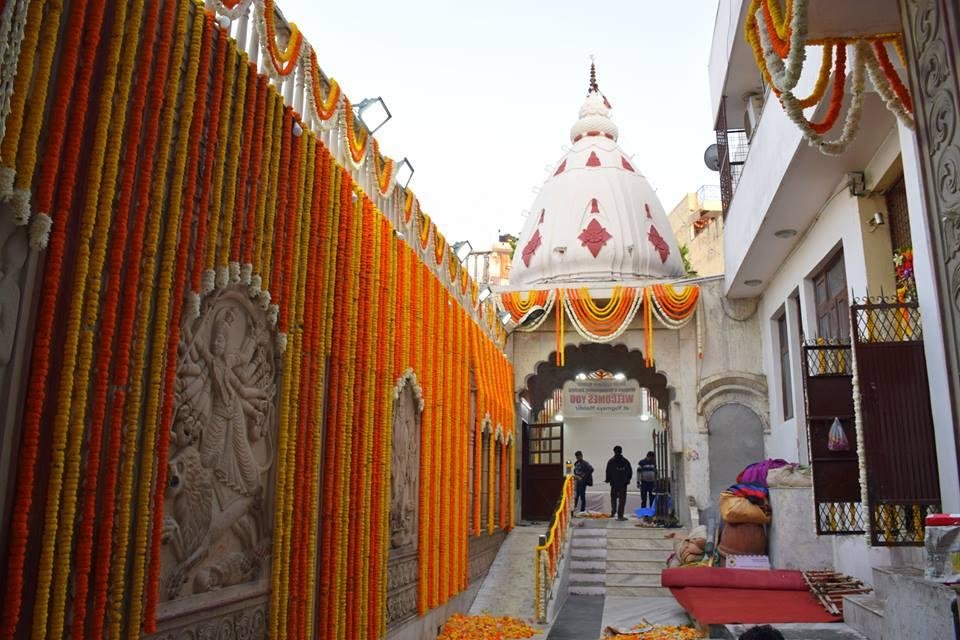
Yogmaya Temple, Mehrauli – An Ancient Devi Shrine in Delhi’s Historic Heart
Yogmaya Temple, also known as Jogmaya Temple, is a revered Hindu shrine situated in Mehrauli, South Delhi. Dedicated to Goddess Yogmaya, the temple stands within one of Delhi’s oldest continuously inhabited areas, close to the Qutub complex, Lal Kot’s historic landscape and several important monuments associated with different periods of the city’s history.
The temple is spiritually significant for devotees who worship Yogmaya as the divine energy of Lord Vishnu and as the sister of Lord Krishna. Local tradition connects the sacred site with the Mahabharata era and the Pandavas, while the structure visible today largely reflects reconstruction and patronage from the early nineteenth century.
Yogmaya Temple is also closely associated with **Phool Walon Ki Sair**, Delhi’s historic festival of flowers and communal harmony. During this tradition, floral offerings are presented both at the Yogmaya Temple and at the nearby dargah of Sufi saint Qutbuddin Bakhtiar Kaki.
Pilgrims visiting the temple can combine Devi darshan with Mehrauli’s extraordinary heritage landscape, including the Qutub complex, Mehrauli Archaeological Park, Jahaz Mahal, Zafar Mahal and the dargah.
Travellers searching for hotels near Yogmaya Temple, family accommodation near Mehrauli or pilgrimage-friendly stays close to the Qutub complex can explore suitable options through **MudrasStays**.
## Who Is Goddess Yogmaya?
Yogmaya is worshipped as the divine spiritual power through which the will and sacred activities of the Supreme are manifested.
In Vaishnava tradition, Yogmaya is closely connected with the birth of Lord Krishna. According to the sacred narrative, Krishna was born to Devaki and Vasudeva in Mathura while a daughter was born to Yashoda and Nanda in Gokul.
Vasudeva carried the infant Krishna across the Yamuna and exchanged him with the newborn girl. When King Kansa attempted to kill the child, she escaped from his hands, revealed her divine form and warned him that the one destined to defeat him had already been born.
The Goddess is consequently remembered as:
* The divine sister of Lord Krishna
* A manifestation of Durga or Shakti
* The spiritual power of divine protection
* The force that conceals and reveals sacred truth
* The Goddess who protects devotees from fear and negativity
* A source of courage, wisdom and inner strength
Devotees visit Yogmaya Temple to pray for protection, family welfare, fulfilment of sincere wishes and spiritual clarity.
## Mahabharata-Era Tradition and Historical Evidence
Local religious tradition regards Yogmaya Temple as one of Delhi’s ancient sacred sites connected with the Pandavas and the Mahabharata period.
The surrounding region is identified with the historic settlements of Yoginipura, Lal Kot and Mehrauli. Traditional accounts maintain that an earlier shrine dedicated to Yoginis or Yogmaya existed in this area long before the present structure was constructed.
However, visitors should distinguish sacred tradition from the dating of the existing building.
The temple seen today was substantially built or reconstructed in the early nineteenth century by **Lala Sidhu Mal**, a noble associated with the court of Mughal emperor Akbar II. It is therefore more accurate to describe the present temple as a nineteenth-century structure standing at a site associated with a much older tradition of Goddess worship.
This combination of ancient faith and later reconstruction makes Yogmaya Temple an important example of Delhi’s continuity as a living sacred city.
## Architecture of Yogmaya Temple
Yogmaya Temple is approached through the narrow lanes of historic Mehrauli. Its white shikharas and devotional spaces create a peaceful environment within the dense urban neighbourhood.
Architectural and decorative features include:
* White temple towers or shikharas
* Arched entrances
* A courtyard and approach corridor
* Marble flooring
* Carved pillars and decorative panels
* An entrance hall leading towards the sanctum
* Shrines dedicated to associated deities
* Floral and religious ornamentation
* Traditional spaces for offerings and prayer
The main form of Goddess Yogmaya is worshipped within the sanctum and is generally adorned with cloth, jewellery and flowers.
Visitors should not touch carvings, temple decorations or sacred objects unless explicitly permitted. Photography rules can differ between the exterior, courtyard and inner sanctum.
## Darshan at Yogmaya Temple
The temple remains an active place of daily worship. Devotees may offer flowers, sweets, chunri and other permitted items to the Goddess.
A suitable darshan sequence may include:
**Temple Entrance – Footwear Deposit – Yogmaya Darshan – Associated Shrines – Quiet Prayer – Prasad**
Visitors should:
* Dress modestly.
* Remove footwear at the designated place.
* Keep mobile phones silent.
* Follow the organised queue.
* Avoid carrying large bags.
* Respect restrictions on photography.
* Use authorised donation facilities.
* Keep children supervised.
* Avoid obstructing other devotees during prayer.
* Maintain cleanliness inside the temple precinct.
Temple opening hours may change during Navratri, festivals, special pujas and maintenance. Pilgrims should confirm the current schedule locally before making a tightly timed visit.
## Puja Offerings and Prasad
Shops around Mehrauli and near the temple may sell basic items used for Devi worship.
Offerings may include:
* Flowers and garlands
* Red chunri
* Coconut
* Incense sticks
* Camphor
* Roli and rice
* Sacred thread
* Sweets
* Dry prasad
* Pictures of Goddess Yogmaya
* Small religious pendants
* Puja baskets
Visitors should confirm which offerings are accepted before purchasing a large basket.
Avoid individuals offering unauthorised priority darshan or guaranteed wish fulfilment. Religious services and donations should be arranged through recognised temple channels.
## Navratri Celebrations
Navratri is one of the most important periods for worship at Yogmaya Temple.
During Chaitra and Shardiya Navratri, the temple may be decorated with flowers and lights, and larger numbers of devotees arrive for darshan, aarti and Devi worship.
Visitors should expect:
* Longer queues
* Increased security
* Special pujas and aarti
* Additional prasad stalls
* Congestion in Mehrauli’s narrow lanes
* Restricted vehicle access
* Greater demand for nearby accommodation
* Early-morning and evening crowds
Families travelling with elderly devotees or young children should arrive early, carry only essential belongings and keep adequate time for walking.
## Phool Walon Ki Sair
Yogmaya Temple plays a central role in **Phool Walon Ki Sair**, also called Sair-e-Gul Faroshan.
This historic flower festival is celebrated as a symbol of Delhi’s shared Hindu-Muslim heritage. Floral fans and offerings are traditionally presented at Yogmaya Temple and at the nearby dargah of Qutbuddin Bakhtiar Kaki.
The festival is associated with the reign of Mughal emperor Akbar II and the royal family’s prayers for the return of Prince Mirza Jahangir. The floral offerings gradually developed into a wider public celebration involving processions, music, cultural activities and residents from different communities.
The tradition represents:
* Religious harmony
* Delhi’s composite culture
* Shared respect for temple and dargah
* The historic flower trade
* Mehrauli’s cultural identity
* Community participation
The festival’s dates, route and programme can change according to administrative permissions. Visitors travelling specifically for Phool Walon Ki Sair should verify the current schedule before booking.
## Visit the Dargah of Qutbuddin Bakhtiar Kaki
The dargah of Khwaja Qutbuddin Bakhtiar Kaki is one of Delhi’s most important Sufi pilgrimage sites and lies within the historic Mehrauli area.
The saint was a respected figure of the Chishti order and an important spiritual predecessor of Hazrat Nizamuddin Auliya.
Visitors from every background may enter respectfully by:
* Covering their heads
* Removing footwear
* Wearing modest clothing
* Maintaining silence
* Following separate access arrangements where applicable
* Respecting prayer and qawwali gatherings
* Avoiding photography without permission
Visiting the temple and dargah together offers a meaningful understanding of Mehrauli’s long tradition of religious coexistence.
## Explore the Qutub Complex
The Qutub complex is situated close to Yogmaya Temple and contains some of Delhi’s best-known historic monuments.
Important structures include:
* Qutub Minar
* Quwwat-ul-Islam Mosque
* The Iron Pillar
* Alai Darwaza
* Alai Minar
* Tomb of Iltutmish
* Other historic remains
The complex requires a separate ticket and adequate time for security checks and exploration.
A suitable itinerary may include:
**Yogmaya Temple Darshan – Qutub Complex – Mehrauli Archaeological Park**
Visitors should avoid attempting all of Mehrauli’s monuments during a very short visit, particularly during summer.
## Walk Through Mehrauli Archaeological Park
Mehrauli Archaeological Park preserves monuments and archaeological remains from several periods of Delhi’s history.
Visitors may explore recognised routes covering sites such as:
* Jamali Kamali Mosque and Tomb
* Rajon Ki Baoli
* Balban’s Tomb
* Metcalfe’s structures
* Other tombs, stepwells and ruined buildings
The park should be explored during daylight hours. Visitors should remain on recognised paths, avoid isolated areas and carry sufficient drinking water.
A guided heritage walk can provide more historical context than an unguided visit.
## Visit Jahaz Mahal and Hauz-i-Shamsi
Jahaz Mahal is a historic building near the reservoir known as Hauz-i-Shamsi. Its name refers to its appearance like a ship beside the water.
The site is connected with Mehrauli’s medieval history and the cultural landscape of Phool Walon Ki Sair.
Visitors can combine:
**Yogmaya Temple – Jahaz Mahal – Hauz-i-Shamsi – Qutbuddin Bakhtiar Kaki Dargah**
The surroundings are active residential and commercial areas. Travellers should follow local access routes and avoid entering unsafe or restricted sections.
## Visit Zafar Mahal
Zafar Mahal is a late Mughal palace in Mehrauli associated with emperors Akbar II and Bahadur Shah Zafar.
The complex preserves gateways, courtyards and architectural remains representing the final period of Mughal royal patronage in Delhi.
Its connection with Akbar II makes it particularly relevant to the story of Phool Walon Ki Sair and Yogmaya Temple.
Access conditions may change because of conservation work, encroachment or security arrangements. Visitors should confirm current entry before travelling specifically for the monument.
## Best Time to Visit
Yogmaya Temple can be visited throughout the year.
### October to March
The cooler months provide comfortable conditions for temple visits and heritage walks.
### Chaitra Navratri
This period offers a strong devotional atmosphere but can bring long queues.
### Shardiya Navratri
Autumn Navratri is another major period for Devi worship and temple decoration.
### Phool Walon Ki Sair
The festival offers an important cultural experience, subject to the annual schedule and administrative approvals.
### April to June
Delhi can become extremely hot. Early-morning visits are preferable.
### July to September
Monsoon rain may make old lanes and heritage sites slippery. Carry rain protection and allow additional travel time.
Weekday mornings outside festivals are generally best for quieter darshan.
## How Much Time to Keep
Visitors can keep approximately one to two hours for Yogmaya Temple darshan and the immediate surroundings.
A half-day itinerary may include:
**Yogmaya Temple – Dargah Qutbuddin Bakhtiar Kaki – Jahaz Mahal**
A full-day heritage and pilgrimage plan may include:
**Yogmaya Temple – Qutub Complex – Mehrauli Archaeological Park – Dargah – Local Meal**
Adequate rest should be included, particularly for senior citizens and children.
## How to Reach Yogmaya Temple
Yogmaya Temple is located within Mehrauli in South Delhi.
Visitors may reach the area by:
* Delhi Metro
* Auto-rickshaw
* E-rickshaw
* Private taxi
* App-based cab
* Local bus
* Personal vehicle, subject to parking availability
**Qutub Minar Metro Station on the Yellow Line** is the most convenient major metro connection, followed by a short road journey towards Mehrauli.
The final approach passes through narrow and congested streets. Large vehicles may not reach the temple entrance directly, and visitors may need to walk from the nearest suitable drop-off point.
Parking is limited, especially during Navratri and Phool Walon Ki Sair.
## Food and Local Facilities
Mehrauli has vegetarian restaurants, local dhabas, sweet shops, cafés, pharmacies and everyday stores.
Visitors may find:
* Dal and roti
* Rajma chawal
* Chole and rice
* Paneer dishes
* Poori sabzi
* Parathas
* Vegetarian thalis
* Samosas and kachori
* Tea
* Sweets and dry prasad
Pilgrims following a strict satvik diet should confirm whether onion and garlic are used.
Food choices are also available around Saket, Qutub Institutional Area and other nearby South Delhi neighbourhoods.
## Where to Stay Near Yogmaya Temple
Travellers may choose accommodation in Mehrauli, Saket, Chhatarpur, Vasant Kunj or nearby South Delhi areas.
### Stay Near Mehrauli For:
* Early temple darshan
* Easy access to the Qutub complex
* Phool Walon Ki Sair
* Heritage exploration
* Short pilgrimage visits
### Stay in Saket For:
* Wider hotel selection
* Restaurants and shopping
* Metro connectivity
* Medical facilities
* Easier family accommodation
### Stay in Chhatarpur For:
* Access to other major temples
* Farmhouse and group-stay options
* Road connectivity towards Gurugram
* Larger pilgrimage itineraries
Before booking, verify:
* Actual distance from the temple
* Final vehicle access
* Parking availability
* Lift or ground-floor rooms
* Family-room configuration
* Vegetarian meals
* Secure luggage storage
* Metro connectivity
* Street and traffic noise
* Festival access restrictions
A hotel described as being near Mehrauli may still require additional travel through crowded local roads.
## Book Stays Near Yogmaya Temple with MudrasStays
**MudrasStays** helps pilgrims discover suitable accommodation near temples, dargahs, sacred heritage corridors and important spiritual destinations.
Travellers visiting Mehrauli can use MudrasStays to explore:
* Hotels near Yogmaya Temple
* Family stays near the Qutub complex
* Accommodation in Mehrauli and Saket
* Rooms suitable for senior citizens
* Hotels near vegetarian restaurants
* Group accommodation for Navratri
* Stays for Phool Walon Ki Sair
* Properties with metro connectivity
* Hotels with secure luggage storage
* Accommodation for Delhi heritage and pilgrimage tours
Choosing a convenient stay near Mehrauli allows visitors to attend early darshan, explore the historic neighbourhood and return comfortably after a full day of temple and heritage visits.
Yogmaya Temple is more than an ancient Devi shrine. It represents Delhi’s continuity across mythology, medieval history, Mughal patronage and modern religious life.
By seeking the blessings of Goddess Yogmaya, exploring Mehrauli respectfully and booking suitable nearby accommodation through **MudrasStays**, pilgrims can experience a meaningful journey combining devotion, history, architecture and Delhi’s shared cultural heritage.